Just Keep Showing Up: Creative Impact Interview No. 2
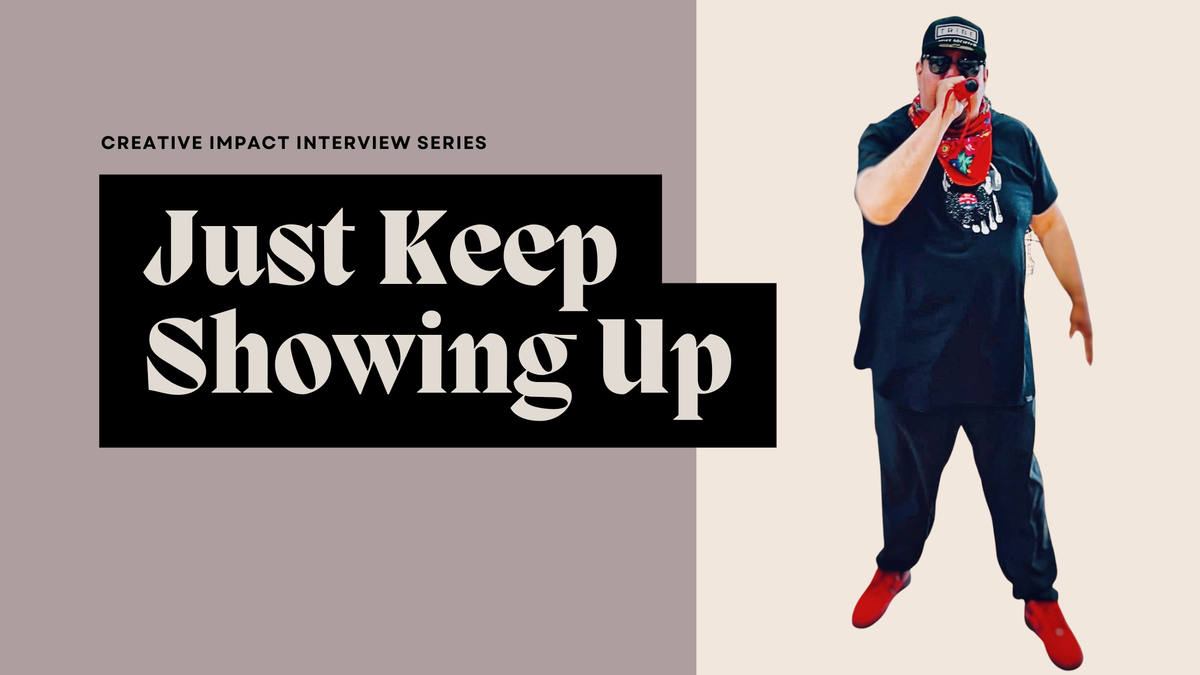
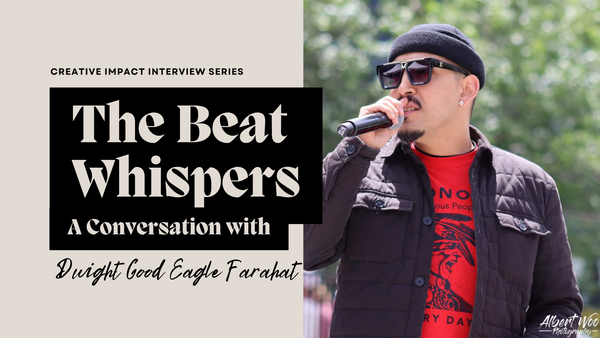
Welcome to our Creative Social Entrepreneur Interview series, where we shine a light on artists building community through creativity, collaboration, and cultural impact. These Q&A-style conversations dive into how social entrepreneurs from across Canada are using their art, voice, and vision to create meaningful change. Whether you’re writing grants, launching your next project, or building something bigger than yourself—these are the stories that fuel inspiration and spark ideas. In interview No. 2, we sit down with Emil Starlight, aka Redfoot.
Redfoot, also known as Emil Starlight, is a Hip Hop artist, producer, and multimedia creator from the Tsuut’ina Nation. He is the founder of Limelight Multimedia, specializing in filmmaking, photography, graphic design, and audio production.
Redfoot’s passion for music began early—rapping himself to sleep as a kid—and took root in 2001 with the group The Brothaz Grimm. He released Tales from the Townsite and produced Rap Rez Tha Basement, which debuted at the first-ever Hip Hop show at Dickens Pub in Calgary.
He has performed across Western Canada, with appearances at Edmonton’s Indigenous Hip Hop Show, Vancouver’s first Indigenous Hip Hop Festival, and the City of Calgary’s Mayor’s Celebration for the Arts. Redfoot also played a key role in organizing Hip Hop’s 50th anniversary in partnership with Tee Pee Treats Indigenous Cuisine, and the 51st anniversary with Tribe Artist Society.
Today, Redfoot serves as the creator and one of the leads of the YYC Mixtape Club—a grassroots collective supporting collaboration, mentorship, and growth for emerging artists. His work continues to center culture, community, and creative empowerment.
Q: Who are you, who do you belong to, and what’s your purpose?
Redfoot: Well, hmm, who am I? I am….I am an artist. That’s weird. I’ve never actually said it out loud before, and it feels weird and emotional. I belong to….hmm. I’m just gonna do this like I would in cypher, just let it come out the top of my head. I belong to my vision. I belong to my purpose, trying to find it and strive toward it. I belong to my art. My art doesn’t belong to me—I belong to it. My purpose is to find that and find my authenticity in that art, and in that, find myself.
My artist name is Redfoot, and that’s actually honouring who I am. My grandmother gave me the name before she passed. She gave me the name Mikadik’adzi. It literally means “his feet are red.” My feet are red. It’s based on my great-grandfather, Pat Grasshopper, who used to paint his moccasins red. He always wore red moccasins, and it’s based on the mallard.
How he got his name was: Pat Grasshopper was afraid of grasshoppers. It was a joke thing. They went out on a raid, stole horses from the United States, and brought them back. They were all energized—“Oh my god, we did this.” When they finally made it back to a safe spot, they set up camp. He was really nervous; he heard something beside him, jumped, and hid. He thought, “They caught us.” And it was a grasshopper. That’s how he got his name.
I’ve also heard stories that he goes by different names. One of the names was Broken Knife. I was thinking of Broken Knife not as one of our mythological people, but as a story about who he actually was—this is going to sound crazy to say out loud, because nobody actually said it —but he was superhuman. There were stories of how the Cree tried to kill him time and time again. They shot him, but the bullets never pierced his skin. He went on a raid in Saskatchewan, and now the place is called Poundmaker’s, and to this day, there’s a hill they call Cut Knife Creek Hill. It’s designated Tsuut’ina land because that battle happened there.
He went out with his battalion, and everybody on his team died. The Cree couldn’t kill him. They gave up and said, “Just go home.” He said, “No, I want to die with my warriors. I’m going to tell you how to kill me.” They eventually killed him, and they honoured that by calling that hill Cut Knife, which means Broken Knife Hill. One of the things I heard is that it was actually Pat Grasshopper, who became Broken Knife, because he was a powerful medicine man. That’s how I got my name.
When I became an artist, on this path of authenticity and trying to find myself and be a better person, I finally decided to honour my name. My feet are red, so I thought I’d just call myself Redfoot. That’s who I am. That’s my name, my authenticity. I’m Tsuut’ina. I’m using that name to honour myself as authentically as I can.
Accepting that name and being called by that name is accepting my authentic self and accepting my purpose in life—to be, as some people would say, an uncle, a mentor, an older person. I’m the oldest person in the Tribe Artist Society crew, and that gives me a responsibility to be a mentor. Not necessarily an elder, but to take on that role as mentor in the best way I can and to help up-and-coming people develop themselves and become their authentic selves so that they can create themselves.
Q: What do you create, and what’s your process like when you create?
Redfoot: My process is: I take time. I take time to sit with ideas. With the crew right now—Tribe Artist Society—we have two songs we perform. There’s a third one we started writing. To create the direction of the songs, it takes time to sit, just to be open. Whenever I force something, I quit. I stop. I get overwhelmed. Then I’m like, “Nope, I’m gonna go play video games.”
I’m finding the more I’m open, the more I just let it come from wherever. Rick Rubin talks about how you’ve got to connect to this thing. Bob Dylan said it, too—something came to him. You’ve got to keep yourself open to whatever connects you to that creativity. Don’t force it. The more you force something, the faster it runs away. You’ve got to find a balance. It’s that flow state.
Even in the cipher, I see some of the guys—they get into that flow state and just let it come. That’s the state of mind you’ve got to be in. Be open, and when it comes, be ready to write it down.
This past weekend, I told some of the homies, “We’ve got to create something else.” They said, “What do you see?” Because I’m producing this thing. I didn’t know. I sat with it for 24 hours, and then it came to me: it’s a story. Everything’s a story.
I remember was listening to Dwight talk about how, at the beginning of Tribe Artist Society, when Monday Rap Night opened, it was just him and Bucho ciphering for months by themselves, waiting. Dwight said, “Should we just pack it up?” He was almost gonna quit, and that’s when people started coming. That would be an amazing song. Have Dwight and Bucho write a song about that—that’s the beginning of this entire thing. Then let the story grow, add the characters, and have this project be that story. Sasha, aka Nasty G, was the one who asked me. “What do you want? What do you see?” I told him it’s a story of the Tribe Artist Society. We got to start with Bucho and Dwight, and that’s how the project needs to begin. This all came to me because I didn’t force it. I told Sasha I’m just going to sit with it because I wouldn’t try to force anything.
Tribe Artist Society teaches Hip-Hop to anybody who wants to learn. I had a song idea and asked Tribe Artist Society, “Why don’t you put your money where your mouth is? Who are you to teach Hip-Hop?” I gave them this beat. At the time, it was Sarah MC Meds, Dwight Goody Does, Nasty G, and Bucho. I said, “Why don’t you write the song: Who’s Tribe Artist Society? What is that?” It became the Tribe Anthem.
That’s where Mixtape Club was born—what if we did this all the time? Artists come, we cook up a beat, write, create, and record in a laid-back studio setting. Give them a space to record their lyrics without paying for time. That’s where Mixtape Club happened, from the Tribe song.
For the 50th birthday of Hip-Hop in 2023, we hosted a Hip-Hop block party in Edmonton. It turned into a mini music festival. We started at noon and ended at midnight—12 hours, over 30 artists. Graffiti writers were doing their thing, DJs were spinning, and we were doing the Tribe Artist Society anthem for Edmonton. It was hype—eight of us on stage. Nasty G couldn’t make it, so Little Chief stepped in, wrote a verse, and did it that night.
That’s when the Tribe Artist Society anthem came out to the world. People were like, “Oh my God, what are they doing in Calgary?” The more we did the song, the more I eventually wrote my own verse for it. That’s what we’ve been performing at the Folk Fest and different places.
This past weekend, we performed a half-hour set at the Music Summit in Lethbridge. From that, they’re like, “Yeah, you get Friday night at the main stage at Folk Fest. You get an hour.” And we’re like—what? Last year, the Roots were there. I met Black Thought on the street. I thought it would be so cool to perform on that stage someday. I’m an older artist. I thought I’d missed my opportunity. But last year we did the Tribe song.
This group from Europe—an international jazz band that’s been going since the 60s, one of the most sampled groups in Hip-Hop—saw us. They told us, “You guys need to be on the main stage.” We hung out with them and had lunch. Sasha knew who they were. I didn’t. One of the main guys sat beside me. Sasha told him I’m an OG. He looked at me and said, “You’re still going?” I said, “Yeah.” He said, “Hell yeah,” and fist-pumped me.
Then I realized: it’s never too late. You’ve just got to show up and keep going. Sometimes I get a little weird—like, I’m an older artist, should I be doing this? But the more I do, the more opportunities open up. The more I just show up and let things happen, the more I’m asked to perform.
Luke Little Chief asked me at the beginning of the year, “What do you want to happen this year?” I said, “I want to perform.” I accepted some shows at the beginning of the year that weren’t the highest class, not at the Palace —but those communities are amazing too. I didn’t care. I wanted to perform. Within a short time, I performed a couple of times and then suddenly I’m headlining two shows in June and July. Then we opened for T-Pain because some of us are on Ricca Razor Sharp’s song. He got asked to open for T-Pain and said, “You guys want to join?” And we’re like, “Yeah.”
Just showing up, letting things happen, not forcing, trying your best. Not second-guessing yourself. Just show up. Be there. Be open. That’s my creation process—just letting it happen.
Back in the day, I used to just write without thinking. Whatever came to mind—even if it felt silly, even if it was throwaway—it had something raw in it. Some of those lyrics actually hit hard. They were good, and they were real. I try to hold onto that now—staying true to myself, not over-censoring, just letting it flow.
But now I’m also learning to bring in more structure. Sasha showed us how to really organize a song—lay out your ideas, think about the message, and then work backwards. That’s something I’m still learning, but it’s helping.
Usually, I just grab my phone or my notebook and start freestyling ideas. Then I go back and reshape them, line them up with the beat. It has to be in time. Once it clicks, it feels like I’m riding the beat—not just rapping, but making it almost sing-song. That’s become part of my style.
I’m also leaning more into singing. I’ve got one soul/R&B song in my set now, and people have encouraged me to do more of that. So I’ve started. I’ve got a couple of new tracks in the works where I’m exploring that side. So yeah—that’s my process. I write. I let it out. And then I shape it.
Q: What are you working on right now?
Redfoot: I’m in the process of starting to create my solo EP—five songs or maybe an album if it comes faster. I’m starting to sing more in my songs—more soul R&B type. I’m working on that. At the same time, I have to sit with the Tribe Artist Society team and decide what we’re going to do. Are we going to make an album? Or keep it to performances?
I’d love to produce a Tribe Artist Society album. Dwight had a square record with the traditional logo. I’m picturing it. That’s what the record would look like. But everybody has to be on board. I don’t want to do it all myself. Nasty G (Sasha) is a really good music producer. I want to lean on him. He’s so good. I’ve been making Hip-Hop since 2000, but there’s a lot I didn’t pick up. The way these guys produce now, they really know how to get into it, make bridges, cut things out, and mix better. I’m learning from them. I’ve been doing this for over 20 years—26 years now. I want to perform more.
Q: What’s your dream project or opportunity?
Redfoot: My dream project would be the Tribe Artist Society album. And I’ve always wanted to perform at the Palace in Calgary. I really love that venue. We’ve seen Souls of Mischief there. Seeing the people rush the stage—just having that many people. We kind of had a taste of it at the T-Pain thing. But yeah, the Palace is one place I’d like to perform. I’d also like to perform at a festival where there are 30,000 people. Fill a crowd.
Q: What kind of impact do you hope to make?
Redfoot: My biggest mission is to tell the world that Indigenous people are still here. We’re still here. We still have a voice. We’re not as noble and quiet and stoic as Hollywood would let you believe. We’re still here. Some people in Calgary live their whole lives not even knowing there’s a reservation across the street from them.
I hurt my knee earlier this year carrying equipment up stairs. I went for X-rays a week later. The lady checking me in asked for my address. I gave her my address, said Tsuut’ina. She said, “No, it has to be English.” I said, “No, that’s English. We’re in the southwest.” She didn’t even know what I was talking about.
Another person came here from Africa and said, “You know you’re in Africa when you’re in Africa. You see everybody. You’re in China, you see everyone. You’re in India, you see all the brown people.” He said, “When I came to Canada, I didn’t see any Indians. I didn’t see the Indigenous people. I thought they would be everywhere.” He said he’d really like to learn more. I thought, wow, people really do think we’re extinct. So, for me, getting Indigenous awareness out there is the impact I want to make.